Crypto Crime Slang Explained: Types of Liao, Liao Laundering, and Liao Adulteration

Organized crime networks in East and Southeast Asia use a large body of coded language marked by distinct regional characteristics, cultural attributes, and industry-specific meanings. This creates a significant barrier to understanding for investigators and researchers, particularly those unfamiliar with the Chinese language and Chinese culture.
Bitrace plans to continue documenting and explaining this industry slang to help relevant professionals conduct their work more effectively. This article, the second in the series, introduces a term specific to Chinese-language online cryptocurrency money laundering: Liao(料).
Liao Laundering(洗料)
Liao(料) carries different meanings across multiple verticals in the gray and black markets. In cryptocurrency money laundering, it specifically refers to fiat currency associated with illegal activities such as fraud and extortion, online gambling, and human trafficking. In most cases, it takes the form of electronic balances held in bank accounts or accounts on other financial platforms that are awaiting laundering.
There are currently several methods for laundering Liao(料), including Card-to-USDT(卡接回 U), QR-to-USDT(码接回 U), Cash-to-USDT(现金车), and Cash-to-Material Assets(实物车), with the latter typically involving precious metals or other highly marketable goods. Despite their different forms, the underlying logic is the same: converting traceable fiat currency in electronic form into harder-to-trace cryptocurrency, goods, or cash to evade law enforcement action or scrutiny by financial platforms.
This article uses Card-to-USDT(卡接回 U), the most common method, as an example.
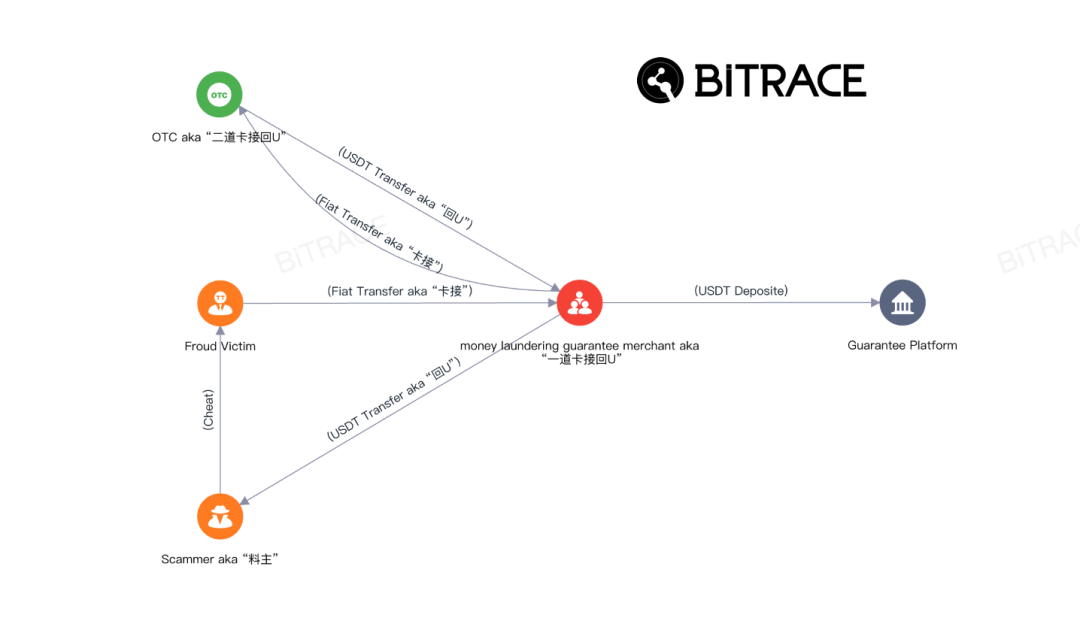
In a typical money-laundering model used in romance fraud, a First-hand Card-to-USDT(一道回 U) Guarantee Public Group Merchant(公群商家) must first post a deposit on a guarantee platform. The merchant then accepts orders and uses bank cards to receive fiat currency directly from victims, purchases USDT at a premium from a cooperating Second-hand Card-to-USDT(二道回 U) Guarantee Public Group Merchant(公群商家), and finally transfers a portion of the purchased USDT to the fraud operators. In this example, the first-hand and second-hand merchants jointly complete the laundering process and earn profits. Actual laundering operations, however, are far more complex, involving additional layers and a broader range of currency-conversion methods.
In general, the lower the tier and the closer it is to the victim, the greater the likelihood that the funds will be judicially frozen, the more likely frontline money launderers are to be arrested, and the higher the commission rate that laundering merchants can earn. In other words, First-hand Liao(一道料) is more dangerous than Second-hand Liao(二道料).
Types of Liao(料性)
The previous section explained that Liao(料) can be classified by risk according to the stage of laundering, with money-laundering services priced accordingly. This section introduces additional methods of classifying Liao(料).
Classification by Victim Type
Pupil Liao(小学生料): Funds defrauded from primary school students. Fraud operators typically approach victims under the pretext of video game top-ups or supporting an idol, then intimidate them into secretly transferring their parents' funds by threatening that their parents will otherwise lose their jobs or face judicial investigations;
Part-time Job Liao(兼职料): Funds obtained by creating fake communities or apps and using purported part-time earning opportunities to induce victims to transfer money to designated accounts or purchase specified fraudulent products. Victims of this type of fraud are primarily stay-at-home mothers, university students, and similar groups;
Se Liao or Porn Liao(色料): Illicit proceeds obtained by using prostitution, pornography, or similar pretexts to induce victims to participate in investments, wealth-management schemes, or paid tasks, before ultimately deceiving them into providing funds;
Pig Butchering Scam Liao(精聊料): Funds obtained by fabricating an identity, developing an online romantic relationship with a target, inducing the victim to participate in a fraudulent investment project, and ultimately extracting a large sum. When the victim is Chinese, this method is known as a Pig Butchering Scam(杀猪盘); when the victim is Western, it is known as a Sheep Butchering Scam(杀羊盘).
Classification by Crime Type
Online Gambling Liao(博彩料), also known as BC Liao(BC 料) or Spinach Liao(菠菜料): Fiat currency deposited by gamblers on online gambling platforms. These funds require basic laundering before they can be moved, a process commonly known as Running Point(跑分);
Ponzi Scheme Liao(资金盘料): Funds paid by participants in a Ponzi scheme or multilevel marketing operation to their superiors. Because such schemes often continue for several months, money launderers have ample time to process the funds;
Chinese Authority Impersonation Liao(公检法料): Funds illegally obtained by impersonating personnel from China's public security, procuratorial, or judicial authorities and defrauding members of the public. Because many Chinese international students have fallen victim to this method, the FBI specifically coined the term "Chinese Authority Impersonation" in a report.
Liao Adulteration(掺料)
The preceding sections briefly introduced several common types of Liao(料). Differences in the type and life cycle of the underlying illegal activity, as well as the type of victim, affect the timing and intensity of intervention by judicial authorities. From the perspective of money launderers, this means that different types of Liao(料) have different levels of Toxicity(毒性) and should therefore command different commission rates.
For example, gamblers rarely report themselves and the online gambling platforms they use, making Online Gambling Liao(博彩料) relatively low-risk and subject to the lowest commission rate. Victims of Ponzi schemes are also unlikely to file reports during the months before the operators abscond, until the final participants become completely unable to recover their funds. A low rate applies in the early stages, while a high rate applies to the final tranche. In Chinese authority impersonation fraud, victims almost always contact law enforcement quickly, making the funds the most susceptible to judicial freezing and the most costly to launder.
As a result, a relatively common form of deception exists in the money-laundering sector: Liao Adulteration(掺料). This occurs when a Liao Owner(料主) claims that the funds to be handled by a laundering group are low-risk Liao(料), but actually delivers another, higher-risk type. The objective is to reduce laundering fees. The consequence is that the laundering group underestimates the Toxicity(毒性) of the Liao(料), causing bank cards and cryptocurrency wallets to be subjected to risk controls.
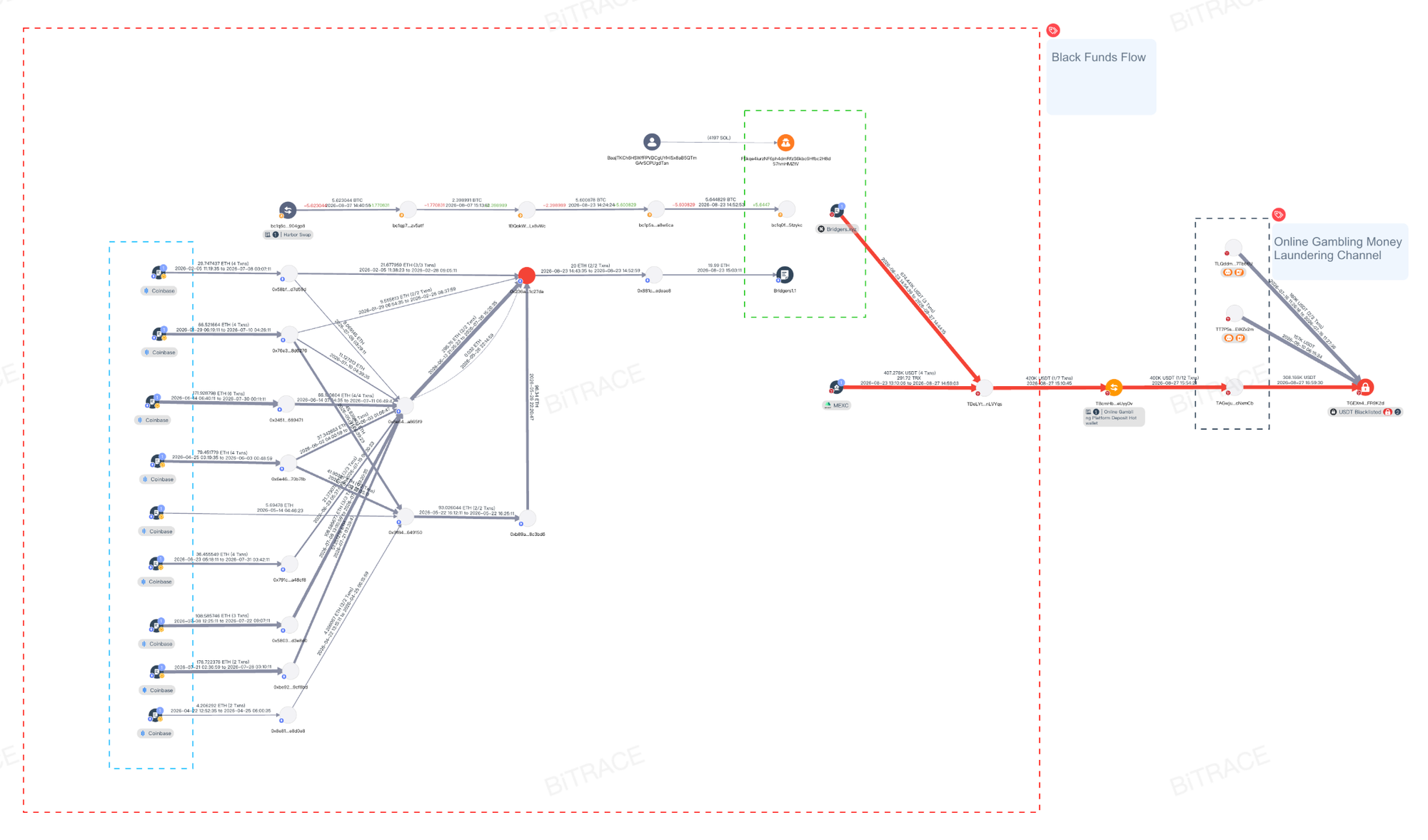
Consider the Tron address TGEXn4HzdRHz83cNqGCobAzg558VFR9K2d, which was frozen by Tether on September 2, 2026. The address belonged to a downstream Running Point(跑分) operation serving an online gambling platform. After receiving a large amount of funds associated with an unidentified incident involving Coinbase, it became the subject of coordinated enforcement action by the exchange and Tether, ultimately losing more than $625,000. This illustrates the consequences of Liao Adulteration(掺料).
Conclusion
From the perspective of a case investigator, this article has provided a brief introduction to laundering methods, fund types, and financial threats in the cryptocurrency money-laundering sector. It is intended to help researchers in different countries conduct intelligence investigations into Chinese-language money-laundering networks more effectively.
Exchange risk-control teams and OTC practitioners should also remain alert to such threats to prevent their operational addresses from becoming subject to judicial restrictions.
Contact us:
Website: www.bitrace.io
Email: [email protected]
Twitter: @Bitrace_team
LinkedIn:@bitrace tech