UNODC Report Analysis: TRON USDT Has Become Financial Settlement Infrastructure for Illicit Industries

On July 21, 2026, the United Nations Office on Drugs and Crime (UNODC) released its latest report, An Interconnected Criminal Ecosystem: Transnational Organized Crime Threat Assessment for South-East Asia. The report concludes that transnational organized crime in Southeast Asia has evolved from discrete criminal activities into an interconnected, cross-border, technology-driven criminal ecosystem that shares infrastructure.
The report describes Tether-issued USDT on the TRON Network blockchain as “financial settlement infrastructure” connecting multiple organized crime markets in Southeast Asia, including but not limited to fraud, trafficking, gambling and drug networks.
This article examines the report’s cryptocurrency-related findings and adds selected insights from Bitrace intelligence.
Converging Criminal Markets
The report concludes that drug trafficking, cyber-enabled fraud, illegal gambling, human trafficking, money laundering, environmental crime, and the illicit trafficking of tobacco and firearms no longer operate entirely independently. Instead, they share personnel, capital, logistics and protection networks.
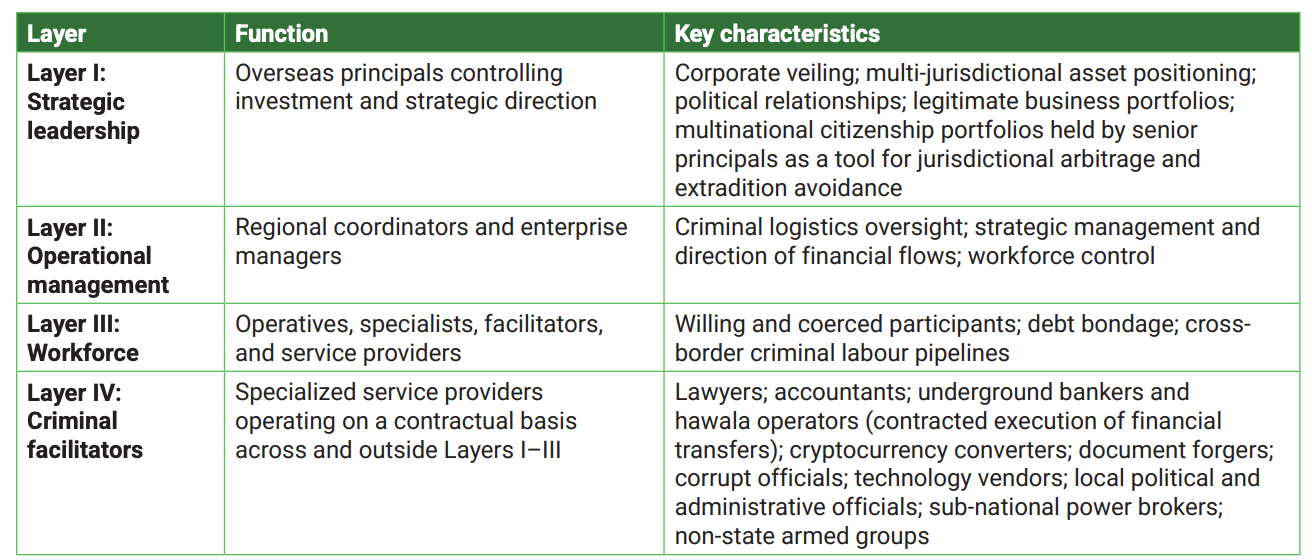
The report’s authors divide Southeast Asian transnational criminal organizations into four tiers. The first tier comprises strategic leadership responsible for core functions such as corporate concealment, cross-jurisdictional arbitrage, and the management of political and business relationships. The second consists of operational managers responsible for running specific companies or organizations. The third is the labor division, which recruits rank-and-file workers for illicit organizations through coercion or deception. The fourth comprises external service providers that supply criminal organizations with services including legal representation, accounting, cryptocurrency exchange and technology development.
In its case investigations, Bitrace has observed that a typical compound may provide property-management services to both illegal online gambling operators and fraud companies. These businesses also rely on illicit cross-border human-trafficking service providers and illegal payment instruments for recruitment and money laundering. Participants affiliated with different criminal entities and crime types coordinate organically in response to price signals, giving the broader criminal economy highly market-oriented characteristics.
TRON USDT Has Become the Dominant Settlement Instrument
The report concludes that TRON USDT has effectively formed a financial channel parallel to the banking system, particularly for fraud, illegal gambling, underground banking and money laundering.
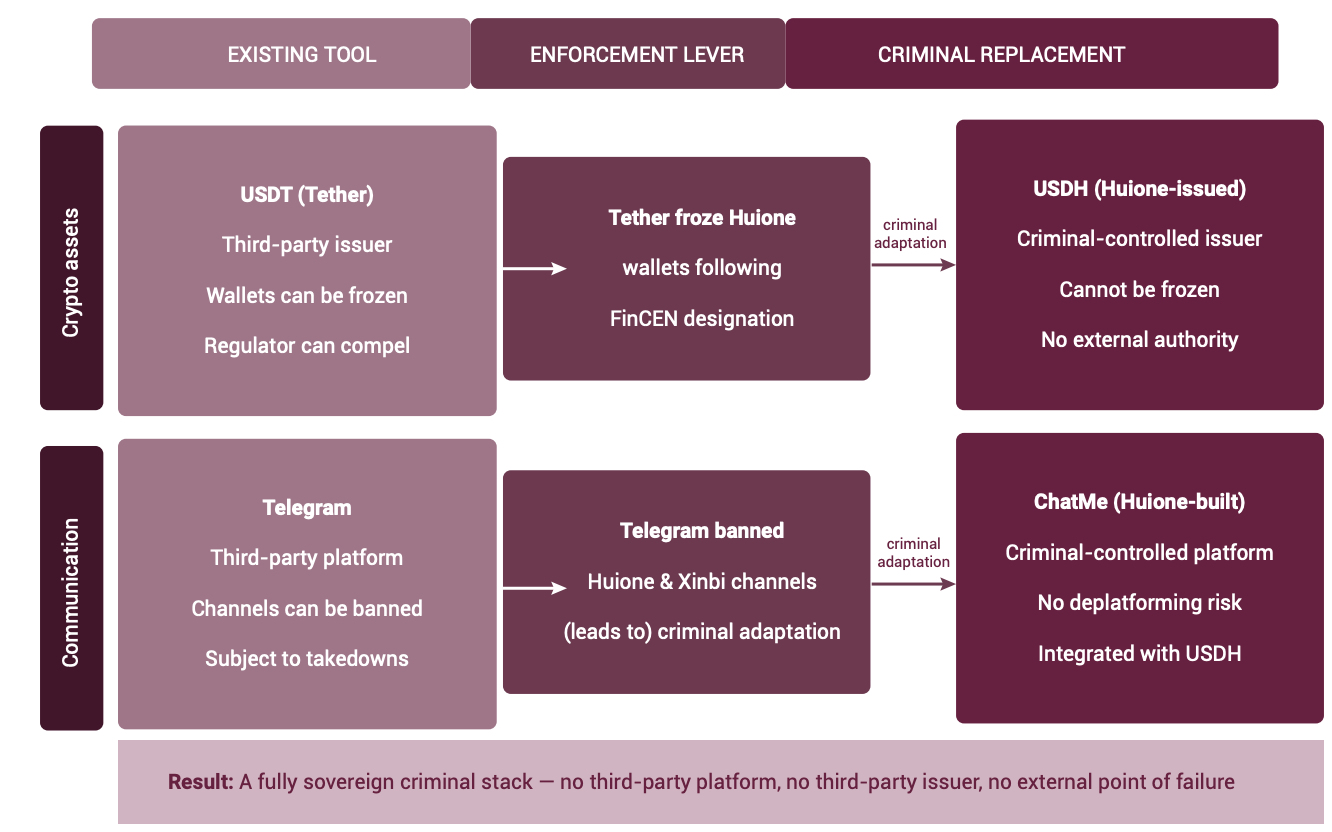
The report highlights Huione Guarantee and Xinbi Guarantee, noting that the two guarantee platforms used TRON USDT to provide tens of billions of dollars in transaction services to local criminal industries.
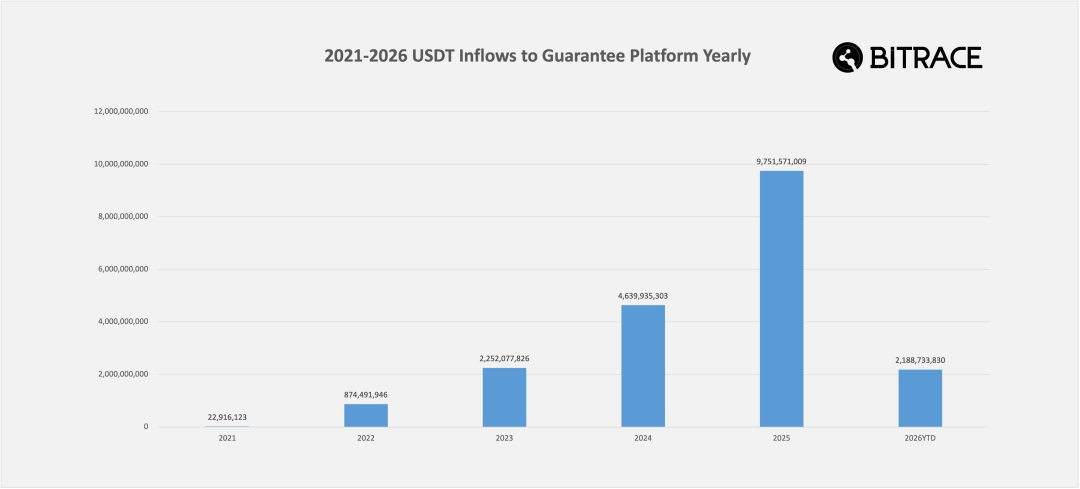
According to data disclosed in Bitrace’s 2026 Southeast Asia Organized Crime Report, more than 100 guarantee platforms, including Huione Guarantee and Xinbi Guarantee, processed over $9.7 billion in transactions in 2025, nearly all of them conducted through TRON USDT.
The Globalization of Human Trafficking
The report concludes that Southeast Asia’s criminal ecosystem has become globalized: it recruits human-trafficking victims worldwide, defrauds victims around the world, and moves funds through international financial and cryptocurrency networks.
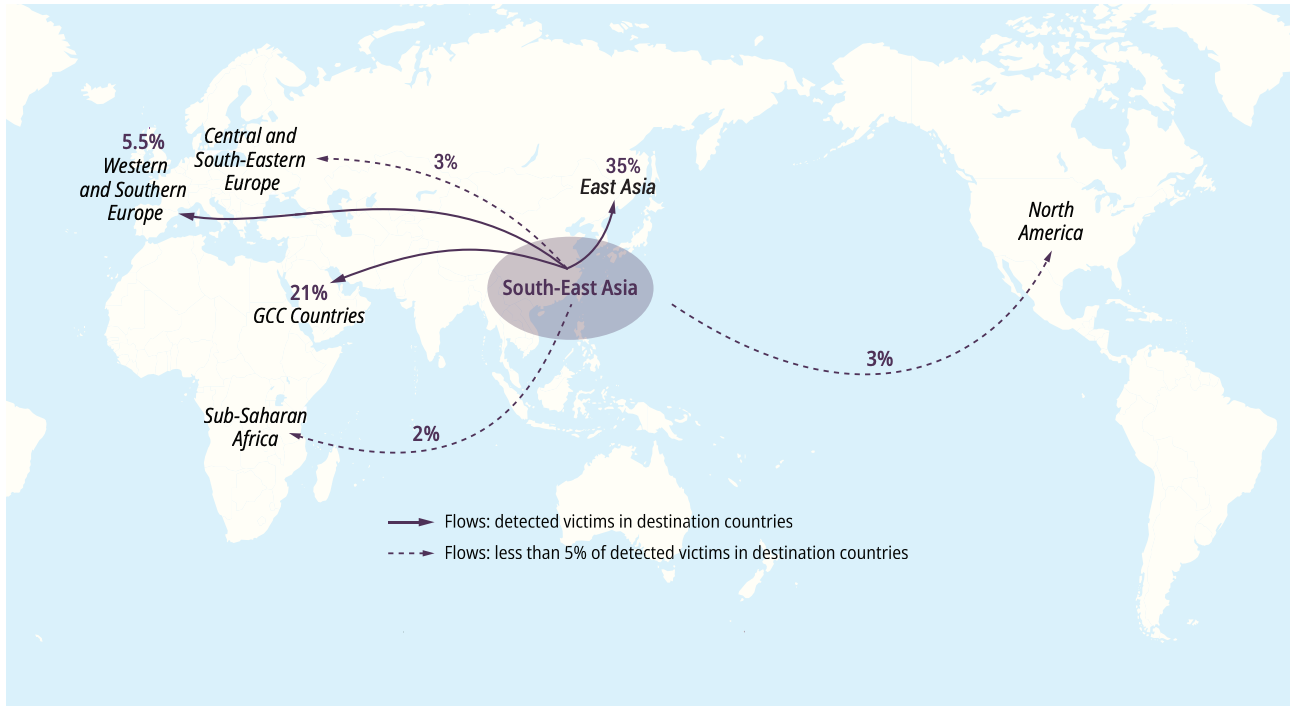
The report details how human-trafficking victims from around the world are routed through Thailand and delivered to illicit companies. Thai law-enforcement cases show that many victims holding ordinary tourist visas enter legally through Bangkok’s Suvarnabhumi Airport and are subsequently abducted and taken to accommodations arranged by the companies. Some victims who cannot obtain tourist visas are smuggled illegally by sea or overland routes.
Bitrace has long monitored Southeast Asia’s illicit cross-border human-trafficking industry. These two entry methods are known as “Passport” and “Side-road,” respectively. The revenues earned by human traffickers differ substantially, with the former typically costing several thousand USDT more than the latter.
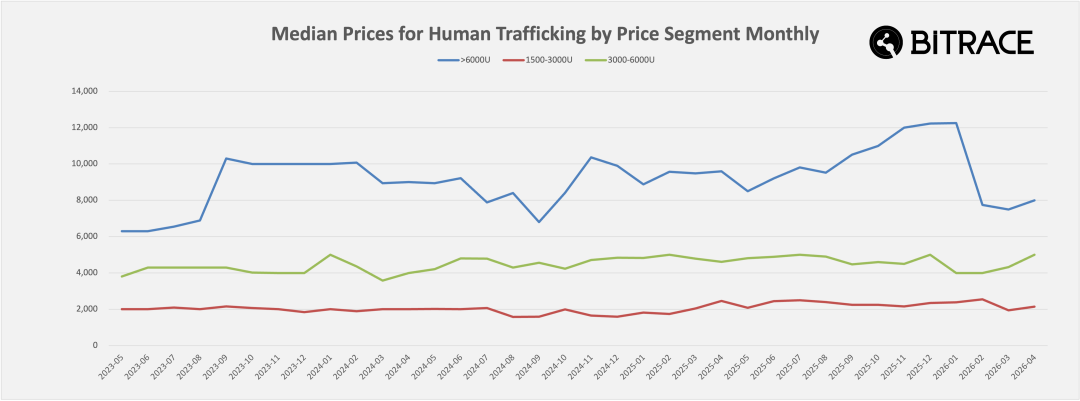
Thailand’s intensified crackdown since 2025 has significantly affected this route. According to Bitrace monitoring, not only has the scale of the Thailand transit route contracted sharply, but its median transaction price has also fallen from 12,000 USDT to 8,000 USDT.
Illegal Online Gambling and Money Laundering
The report concludes that illegal online gambling and cyber-enabled fraud are not entirely separate, but rather different business stages within the same criminal enterprise. Casinos and gambling platforms are used to convert funds in local bank accounts and e-wallets into USDT; transfer gambling proceeds across borders; create apparently legitimate transaction records through low-margin wagering; disguise fraud proceeds as gambling winnings; provide scam compounds with servers, payment systems and personnel; and move funds between fiat currencies and stablecoins through over-the-counter dealers.
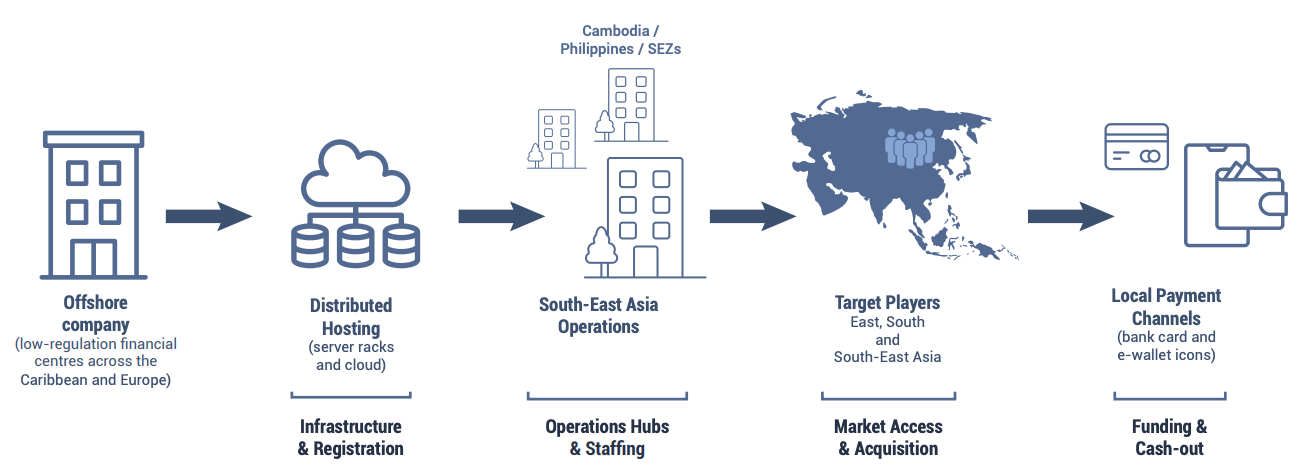
The report states that illegal online gambling platforms in Southeast Asia are often closely linked to local organized crime networks. Their operations are intended not only to extract money from ordinary users, but also, and more importantly, to facilitate money laundering, human trafficking and other forms of organized crime.
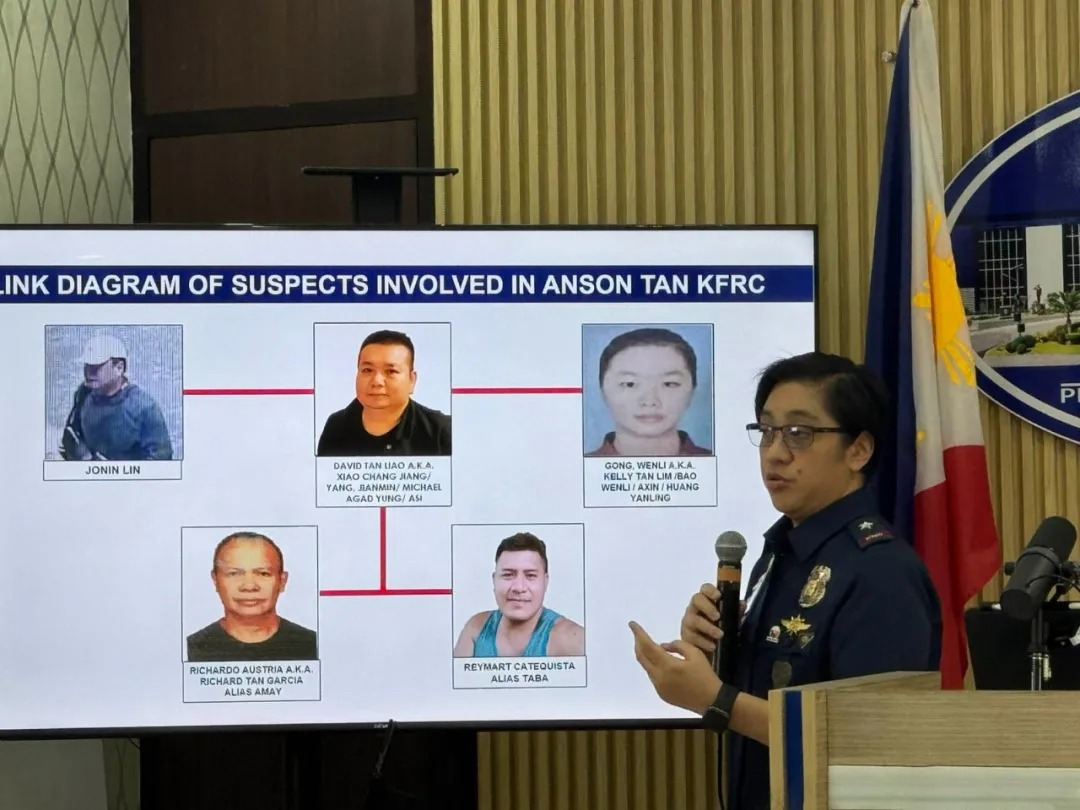
In 2025, Bitrace investigated the kidnapping and murder of Filipino Chinese businessman Guo Congyuan. The 1.365 million USDT ransom initially paid by the victim’s family was transferred through the gambling platforms 9 Dynasty Group/Jiuding Group and White Horse Club/Baima Club.
9 Dynasty Group had partnered with Tiancheng Guarantee, a subsidiary of Dali Guarantee, to launch Jiuding-Tiancheng Guarantee, a Telegram-based transaction guarantee platform for illegal online gambling. Law-enforcement pressure arising from the Guo Congyuan murder case forced the entity to disband.
This case fully aligns with the UNODC report’s assessment: illegal online casinos in Southeast Asia are facilitating local money laundering, kidnapping, fund conversion and fraud.
Conclusion
The report’s authors do not accuse Tether or TRON of participating in local organized crime. Instead, they conclude that USDT on the TRON Network offers low transfer fees and rapid settlement and is not subject to the jurisdiction of traditional financial regulators. These attributes have led illicit entities to adopt the payment instrument at scale, making TRON USDT the foundational financial settlement layer for organized crime networks in Southeast Asia.
These funds are currently being dispersed and laundered through operational addresses used by various illicit entities, contaminating ordinary cryptocurrency infrastructure addresses and creating compliance challenges for operators of centralized cryptocurrency exchanges and payment platforms. Risk-control teams need to develop effective measures to address this threat.
Bitrace is a leading Web3 regulatory technology company in the Asia-Pacific region. Headquartered in Hong Kong, it uses AI and big-data technologies to identify and monitor on-chain risks and criminal activity with greater accuracy and efficiency, providing financial institutions, exchanges, payment companies, regulators and law-enforcement agencies with on-chain fund tracing and anti-money laundering (AML) compliance solutions.
Contact us:
Website: www.bitrace.io
Email: [email protected]
Twitter: @Bitrace_team
LinkedIn:@bitrace tech