Are Prediction Platforms Pricing Global Risk —or Just Running Unlicensed Gambling?
2026 is shaping up to be prediction markets' breakout year.
Polymarket has cemented its influence over global political narratives. Predict.fun has gone deeper into the Binance ecosystem and absorbed rival Probable. Outside capital is flooding in, drawn by prize pools that routinely top nine figures. Legacy regulatory frameworks are struggling to keep pace.
When virtually anything can become a tradeable outcome, the legal reckoning for platforms and users alike is no longer hypothetical — it's already underway.
Market Landscape: From Elections to Everything
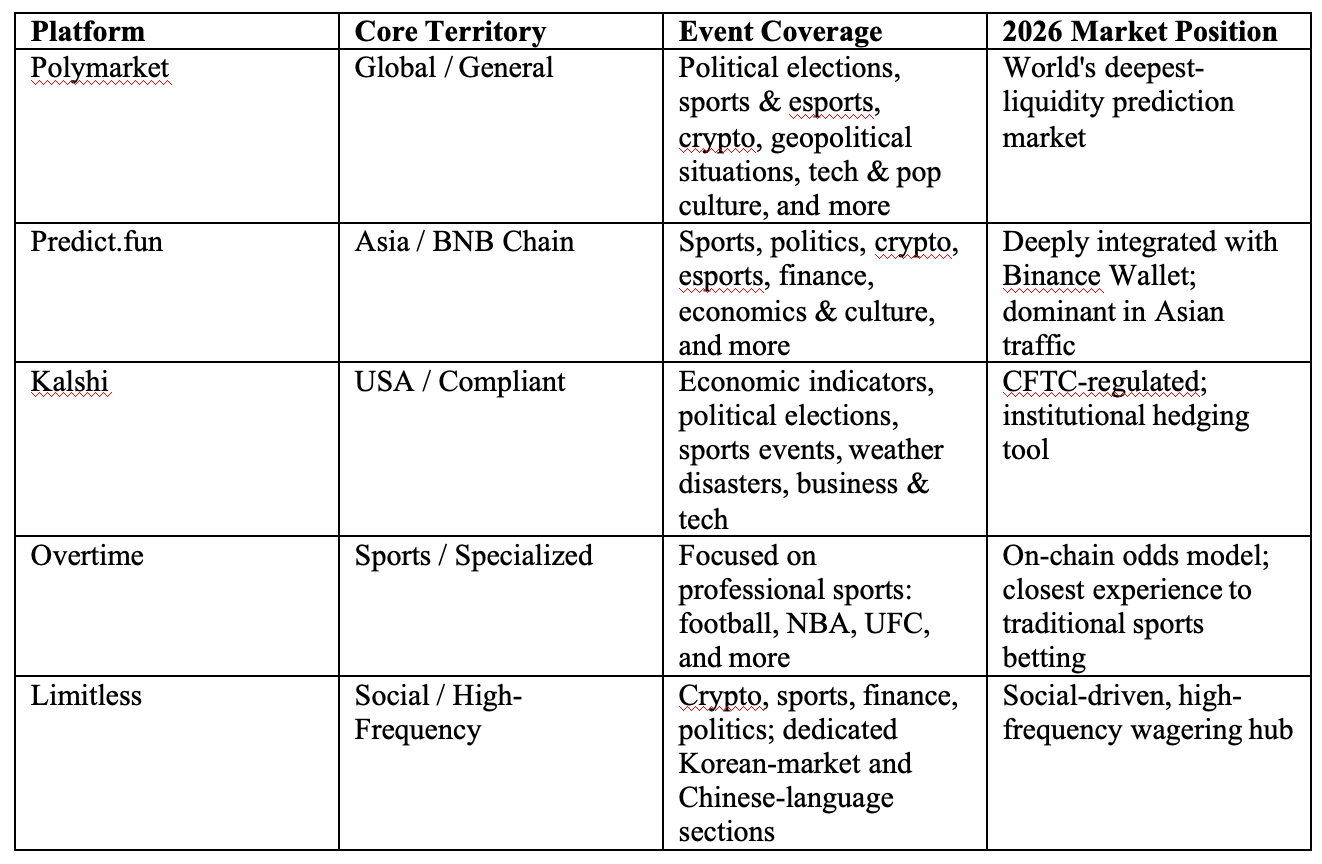
The 2026 prediction market landscape is defined by differentiation. Each major platform has carved out a distinct corner of global uncertainty:
Data from predictions.paradigm.xyz shows Politics ($418.5M in open interest) commanding nearly half the market, with Sports ($340.4M) close behind — a sign that traditional sports bettors are steadily migrating to Web3 platforms. Crypto ($70.6M), Finance, Culture, and other verticals round out the picture, reinforcing the "price everything" thesis that has driven sector expansion
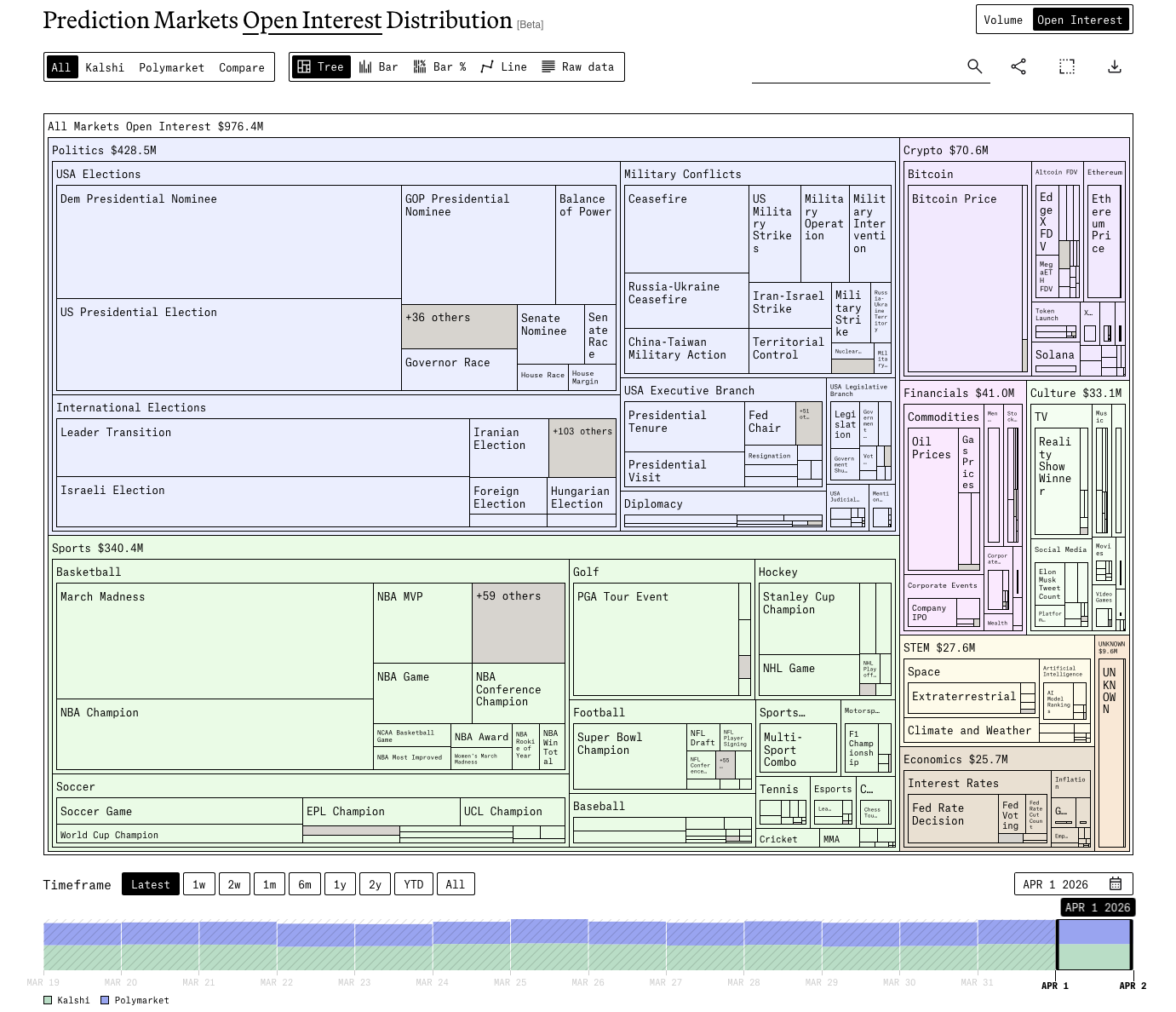
Figure 1: Open interest distribution across mainstream prediction markets. Block size reflects capital volume. (Source: predictions.paradigm.xyz)
Business Model: Fee Structures and How Platforms Make Money
Understanding prediction market economics means breaking down the incentive structure. Two matching models dominate the space.
Order Book Model: Makers (limit-order placers) provide liquidity; Takers (market-order fillers) consume it in exchange for immediate execution.
AMM Model (Automated Market Maker): Prices are fed by oracles; the platform earns through protocol fees or spreads.
In more detail:
Maker: Someone who posts a bid or offer first. Say you think "BTC breaks $100K by month-end" carries 60% odds — you post a buy order at $0.60. Your order rests in the book until someone takes the other side. Makers supply liquidity.
Taker: Someone who accepts an existing quote and executes immediately. If you see a standing $0.60 offer, decide it looks right, and hit "Buy," you're the Taker. Takers consume liquidity in exchange for certainty of fill.
The zero-fee era is over. Platforms now capture revenue through dynamic or tiered fee schedules.
Polymarket
Polymarket rolled out a new fee structure on March 30, 2026. Maker fees are 0% (with rebate incentives). Taker fees follow a probability-linked dynamic schedule.
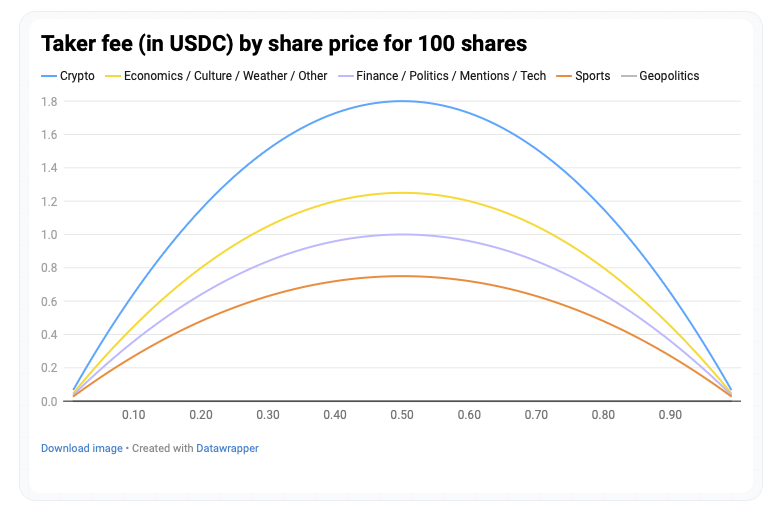
Figure 2: Polymarket's dynamic Taker fee curve. X-axis: probability of event occurring; Y-axis: Taker fee rate.
The logic: when an event probability hovers near 50% — peak uncertainty, peak trading activity — fees are at their highest. As outcomes approach certainty (probability near 0 or 1), fees trend toward zero.
- Crypto: Peak ~1.80% (at ~50% probability)
- Finance / Politics / Culture: Peak ~1.00%
- Sports: Peak ~0.75%
- Geopolitics / World Affairs: Currently 0%
- Expressly approved: Government-sanctioned under the Betting Duty Ordinance (Chapter 108) — regulated horse racing, football betting, and Mark Six, all monopolized by the HKJC;
- Licensed: Licensed by an officer designated by the Home and Youth Affairs Bureau (e.g., mahjong parlors);
- Lawfully exempted: Exempt under Section 3 of the Ordinance (primarily social gambling).
- Platform operators: Providing services without blocking Hong Kong IP addresses could constitute "operating an illegal gambling establishment."
- Promoters: KOLs distributing referral links with commission rebates risk violating the "promoting illegal gambling" offense.
- Capital providers: Depositing via Web3 wallets into non-compliant market categories faces pass-through regulatory scrutiny.
Where the Legal Lines Are
Prediction markets have genuinely solved something traditional gambling operators never could: transparent, on-chain settlement that eliminates the house's black box. When prediction is layered with DeFi yield and AMM revenue sharing, the financial efficiency is real.
But platform operators need to stay current on the legal requirements in every jurisdiction where they operate. Financial innovation and illegal online gambling can look remarkably similar from the outside — and regulators are increasingly inclined to treat them that way.
⚠️ Compliance and Risk Disclaimer: This article is intended for informational and analytical purposes only. It does not constitute investment advice or gambling guidance, and does not encourage any activity that circumvents local laws or regulations. Online gambling and virtual asset derivatives are subject to strict legal restrictions in certain regions, including mainland China and the Hong Kong SAR. Readers should comply with the laws applicable in their jurisdiction and refrain from participating in illegal online gambling.
References
- CFTC Fine and Settlement Announcement: https://www.cftc.gov/PressRoom/PressReleases/8478-22
- FBI Raid on CEO's Apartment: https://www.nbcnews.com/tech/tech-news/fbi-raids-polymarket-ceo-shayne-coplans-apartment-seizes-phone-source-rcna180180
- 2025 Re-Approval to Return to U.S. Market: https://coinmarketcap.com/academy/article/polymarket-gets-us-green-light-after-cftc-relief
- Tennessee Sports Betting Commission Ban: https://www.gamblinginsider.com/in-depth/106291/is-polymarket-legal-in-the-us
- Nevada Court Temporary Injunction: https://finance.yahoo.com/news/nevada-court-blocks-polymarket-raising-091806841.html
- 11 States Issue Joint Cease-and-Desist: https://stateline.org/2026/03/06/kalshi-and-polymarket-are-skirting-laws-on-sports-betting-states-say/
- Maduro Event Suspected Insider Trading: https://www.pbs.org/newshour/nation/a-400000-payout-after-maduros-capture-put-prediction-markets-in-the-spotlight-heres-how-they-work
- French ANJ Investigation and Proposed Block of Polymarket: https://igamingbusiness.com/legal-compliance/french-regulator-block-cryto-operator-polymarket/