Organized Crime Networks: Guarantee Platforms Die, Public Groups Don't

Southeast Asia's illegal cryptocurrency trading guarantee platforms operate on a simple but durable business model: they lease specific Telegram groups to black-market operators, providing transaction guarantees — covering collateral posting, reporting, settlement, and arbitration — in exchange for commissions. The leased groups are known as Public Groups; their tenants are Guarantee Merchants.
That structure has direct implications for enforcement. Taking down a guarantee platform doesn't touch the Guarantee Merchants who actually run the criminal operations. This article traces the evolution of Huione/Tudou Guarantee's directly-operated online gambling network to illustrate how that dynamic plays out in practice.
Huione Guarantee's Online Gambling Public Groups
Huione Guarantee — later rebranded as Haowang Guarantee, then Tudou Guarantee — was a payment guarantee and brokerage platform serving the gray market: online gambling, fraud, money laundering. As regulators and financial institutions intensified pressure, payment accounts and funding channels were systematically shut down. Liquidity deteriorated quickly, withdrawal delays mounted, users rushed to pull funds, and the platform's financial chain eventually snapped.
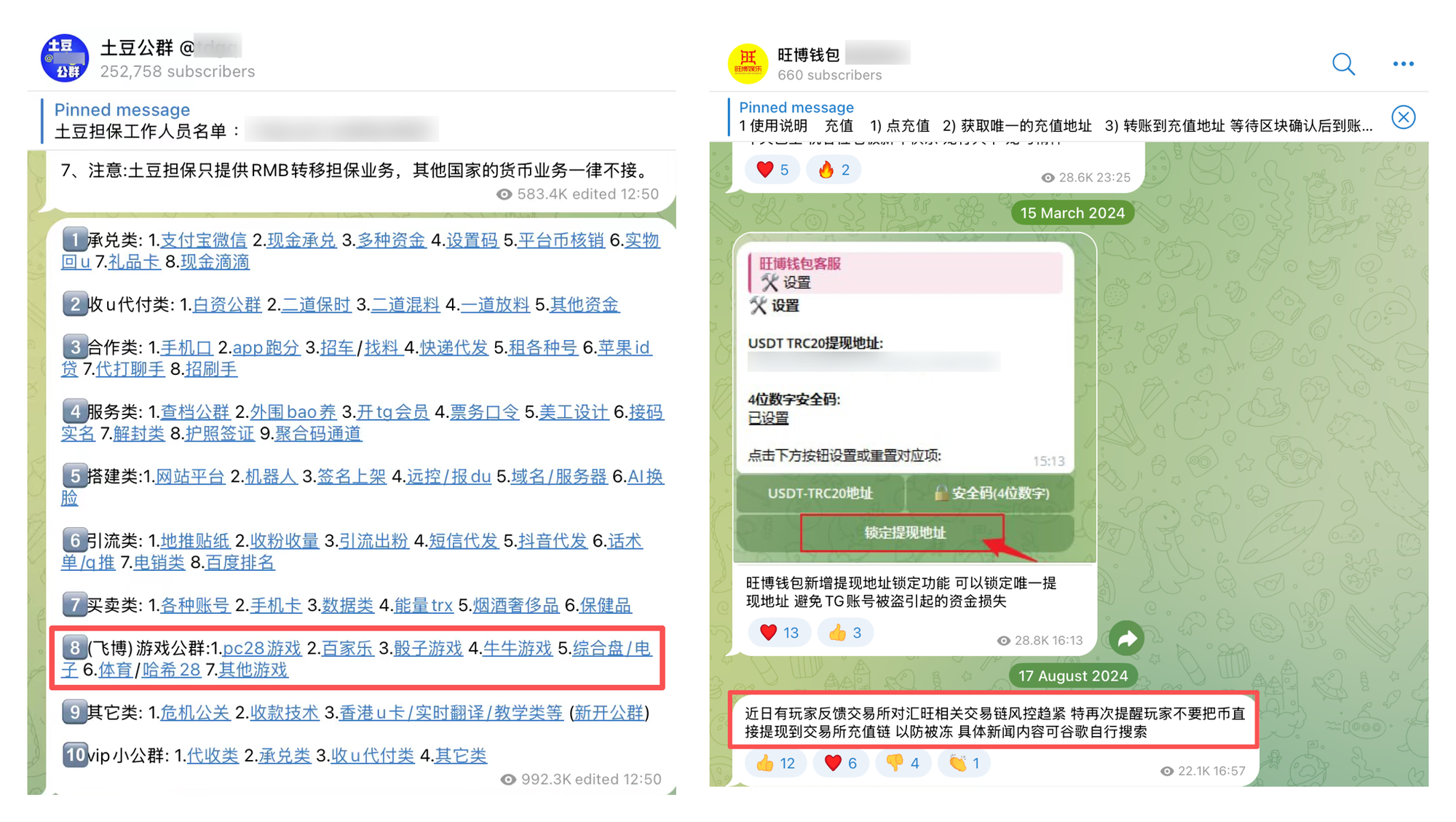
Before it collapsed, Huione's Telegram-based online gambling portal Feibo (@Feibo) ran joint public groups with several prominent gambling platforms. The closest partner was Wangbo (@Wangbo). Huione Guarantee opened traffic-generating public groups on Wangbo's behalf and helped it build WangboWallet — a USDT settlement tool on the Tron network, built on top of Huionepay's SaaS infrastructure.
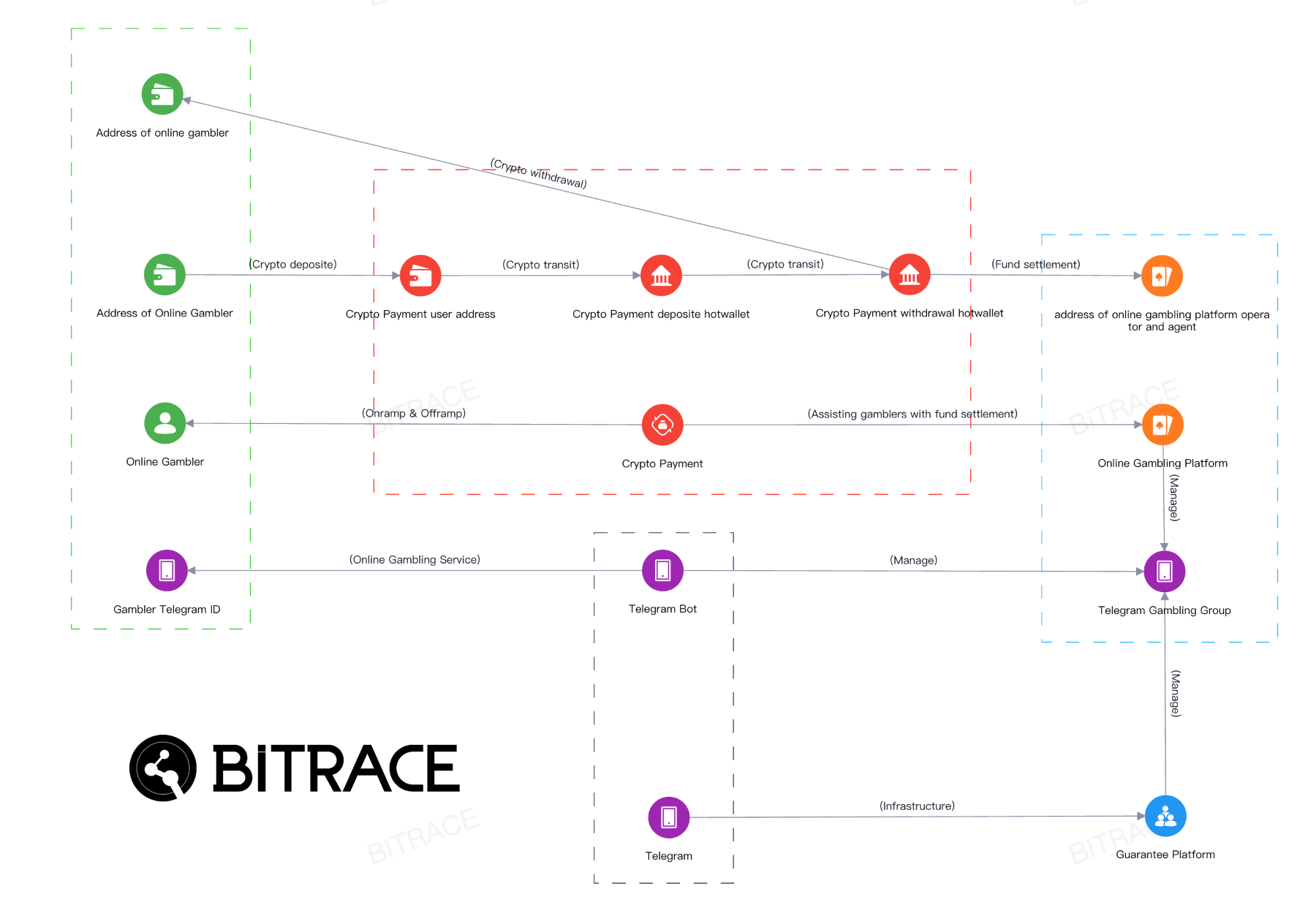
This operational model — Telegram groups layered with an illegal guarantee platform, a crypto payment tool, and an online gambling platform — is now standard across the black-market ecosystem. Intelligence professionals will find the same structure replicated at virtually every guarantee platform operating today.
Wangbo Pivots After Tudou Guarantee Folds
In January 2026, news broke that Chen Zhi — one of the key figures behind the Prince Group — had been extradited to China. The fallout was immediate: Guarantee Merchants launched a run on Tudou Guarantee, withdrawing collateral en masse over several consecutive days. The platform shut down all public group operations and put its entire Telegram group portfolio up for sale.
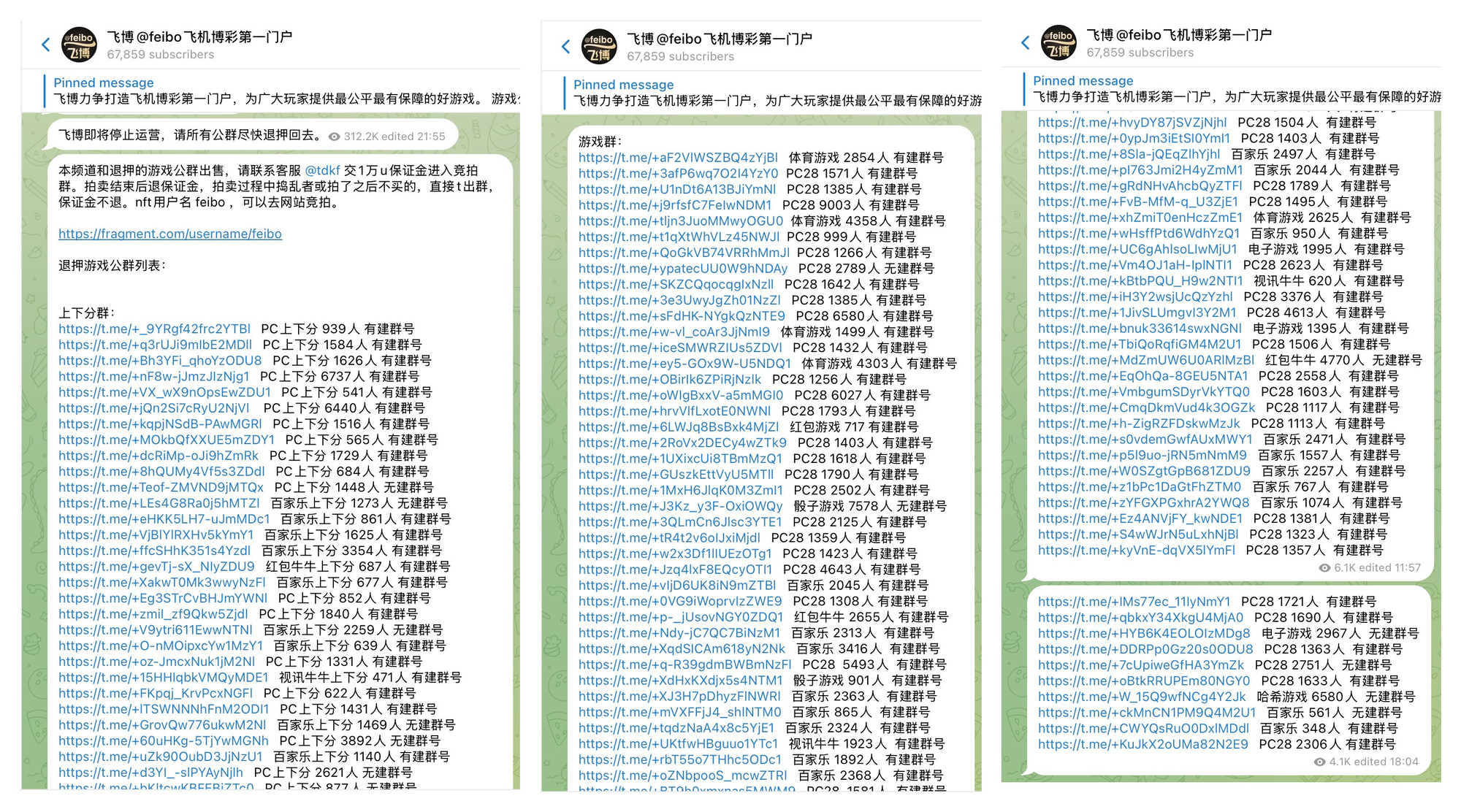
Prominently listed in the auction: the Telegram Name Service (TNS) assets of its online gambling portal, along with large numbers of gambling-related public groups. The NFTs Tudou Guarantee put up for sale refer to collectible username NFTs that Telegram launched on the TON blockchain. Each NFT corresponds to a unique Telegram @username — such as @danbao or @tudou — and can be assigned directly to an account, group, or channel.
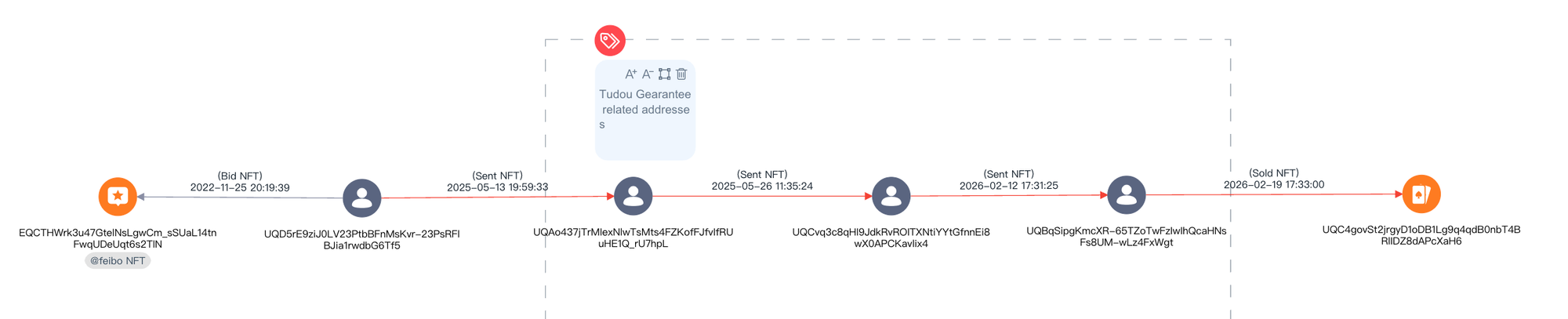
A review of @Feibo's on-chain history is telling. The last ownership change before this one came in May 2025, when legal pressure forced Haowang Guarantee to rebrand as Tudou Guarantee; that transfer was internal. The February 2026 change was an outright sale — a clear signal that the entity's operators had decided to exit the market entirely.
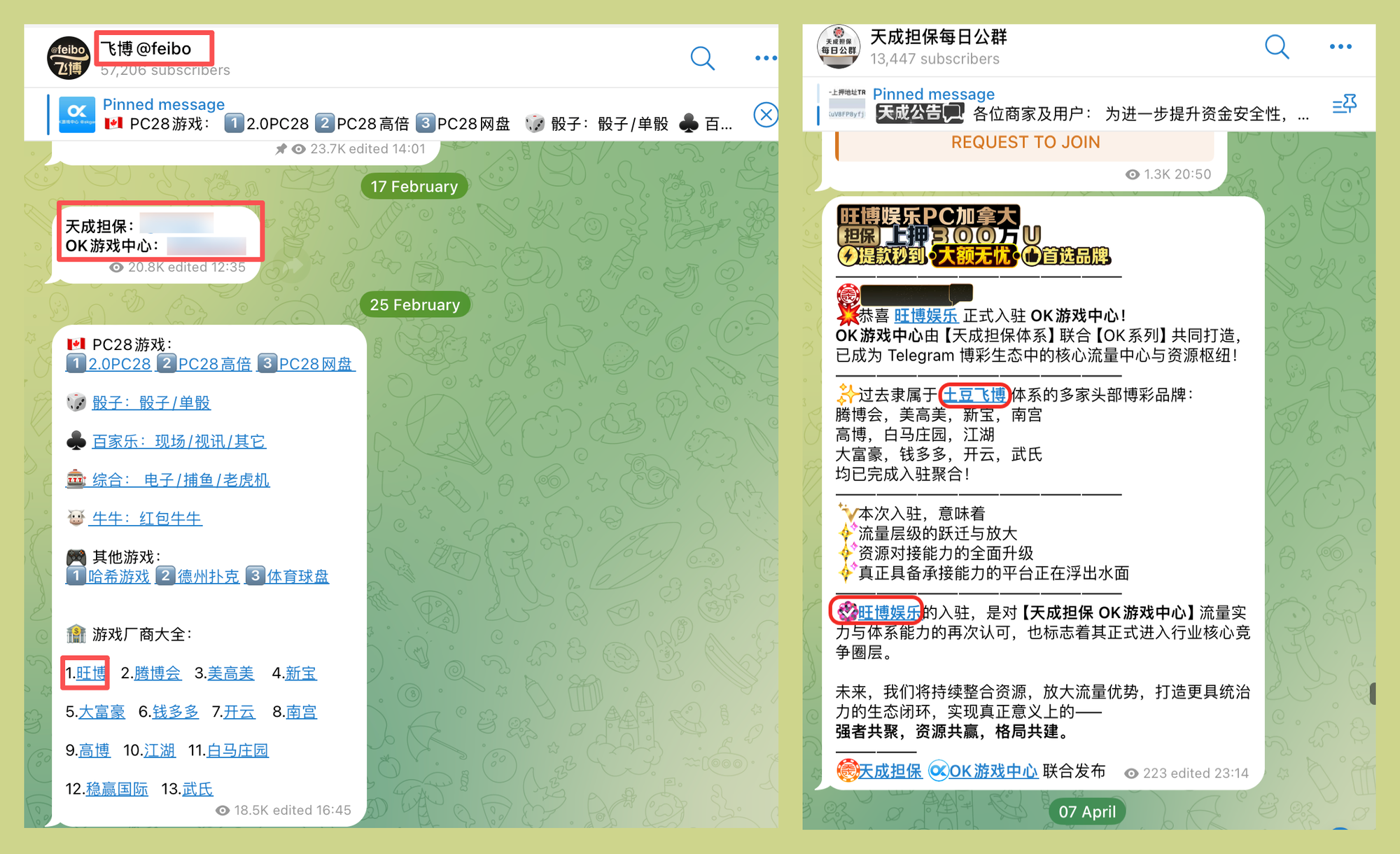
Based on OSINT and TON blockchain analysis, Bitrace is confident that @Feibo and the associated TNS handles and Telegram groups were acquired by Dali Guarantee, currently the sixth-largest platform in the market. They are now being used extensively across Dali Guarantee's Tiancheng Guarantee subsidiary and its OKPAY operations.
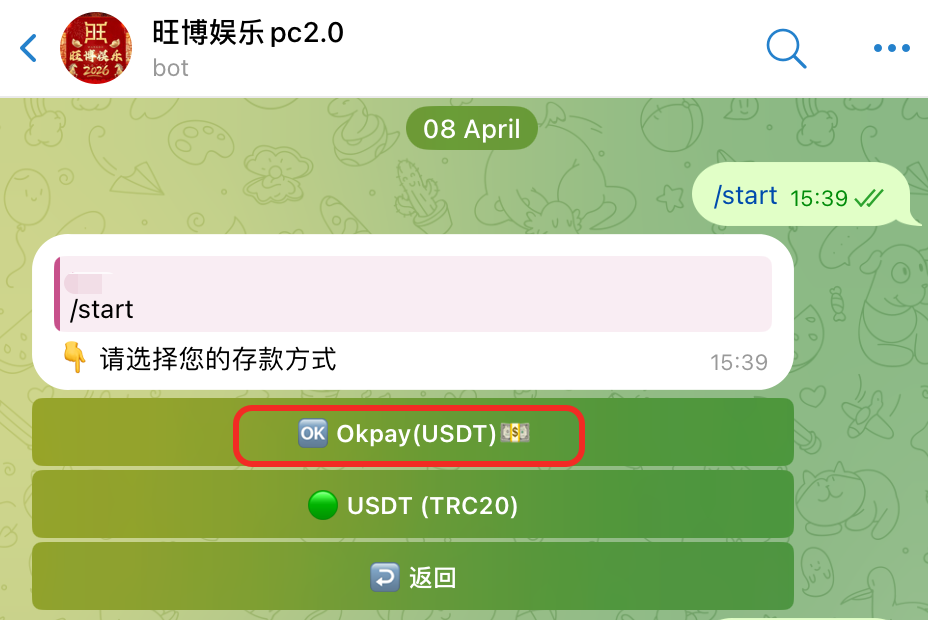
The gambling public groups that previously ran under Tudou Guarantee have similarly migrated in bulk to Tiancheng Guarantee and a venture called OKGAME. Wangbo Entertainment has since onboarded OKPAY as one of its settlement channels.
Wangbo Entertainment: Sizing the Operation
Using the November 2025 Huionepay payment crisis and the February 2026 OKPAY integration as key reference points, Bitrace analyzed USDT transaction activity across Wangbo's official settlement addresses over the preceding 15 months.
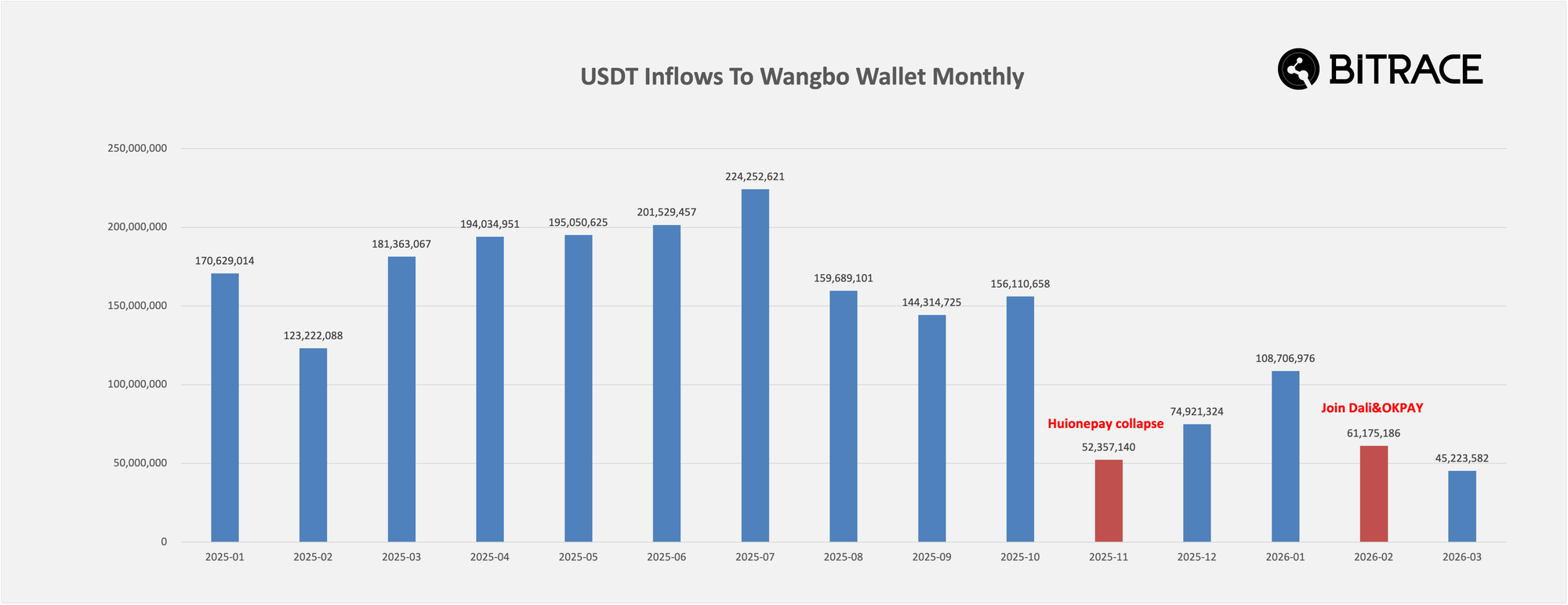
The data shows two clear inflection points:
- November 2025: Total USDT received dropped sharply. Heavy enforcement that month drove user attrition, and Huionepay's shutdown temporarily took WangboWallet offline. Over the following two months, business volumes gradually recovered as users returned.
- February 2026: Following the OKPAY integration, on-chain USDT inflows fell sharply — indicating that a significant share of users had switched to OKPAY's fee-free centralized transfer service.
The conclusion is straightforward: even after Tudou Guarantee shut down, Wangbo Entertainment — one of the entity's primary online gambling public groups — was barely disrupted. By switching guarantee platforms, it simply kept running.
Conclusions
Shutting down a guarantee platform does not end public group operations.
The Tudou Guarantee and Wangbo Entertainment case illustrates just how modular illegal guarantee platform operations are. Guarantee services, public groups, and payment tools are loosely coupled and easily reassembled. Dismantling one component is not enough to destroy the overall criminal ecosystem.
Platform collapse and business succession happen simultaneously.
Neither Huione Guarantee's rebranding in June 2025 nor Tudou Guarantee's complete collapse in January 2026 erased the underlying criminal enterprise. In each case, the operation rapidly rebranded and continued under new cover. The gray/black market ecosystem responds to regulatory pressure through structural reorganization, not exit.
Enforcement needs to target the entities actually committing crimes.
Criminal activity is the nutrient that keeps guarantee platforms alive. Taking down platforms alone does not threaten Guarantee Merchants. Law enforcement should direct more attention toward the entities actually carrying out criminal activity.
Contact us:
Website: www.bitrace.io
Email: [email protected]
Twitter: @Bitrace_team
LinkedIn:@bitrace tech